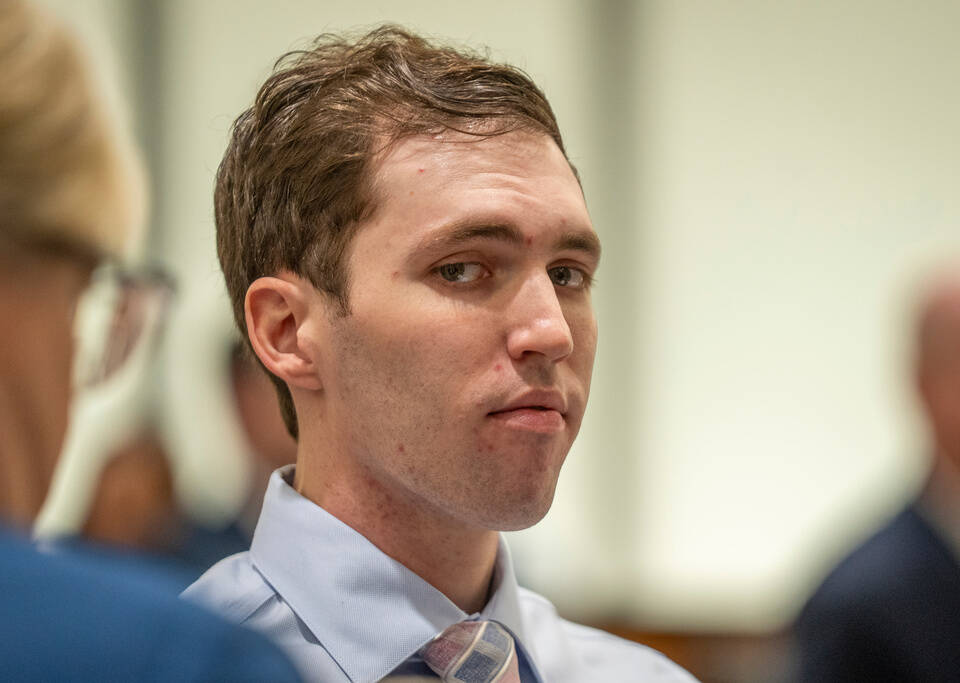
The man accused of murdering Charlie Kirk was back in court this week as his legal team fights to limit what the public can see at an upcoming hearing.
The Oral Arguments
As reported on Wednesday’s AM Update, Tyler Robinson returned to Judge Tony Graf’s Utah courtroom Tuesday as his attorneys delivered arguments on two motions.
The first asks the judge to hold a hearing to decide whether to hold Utah County Attorney Chris Ballard in contempt of court over his appearance on Fox News, where he discussed an Bureau of Alcohol, Tobacco, Firearms and Explosives (ATF) report tied to evidence in the case.
The second motion requests the court deny the media access from certain portions of Robinson’s upcoming preliminary hearing where prosecutors will attempt to demonstrate they have enough evidence to send the case to trial.
Contempt Accusations
The ATF report at the center of the first motion became a flashpoint after Robinson’s defense team highlighted that investigators could not conclusively match a bullet fragment recovered from Kirk’s body to the rifle allegedly tied to Robinson.
Prosecutor Ballard spoke to Fox News and other outlets about the issue, arguing the report was being mischaracterized. The prosecution said the bullet fragment was too damaged for a conclusive match, but was still consistent with the type of round used by the rifle found at the scene.
Defense attorney Richard Novak argued Ballard violated the court’s gag order that bars both sides from discussing the case with the media in ways that could prejudice the jury. He asserted that if prosecutors believed the defense had mischaracterized the report, there were other channels to address it.
“If Mr. Ballard and his colleagues thought that we mischaracterized the ATF report, which we did not, but if that’s what they really believed in good faith, they could have done at least three things,” he explained. “One, they could have filed something with this court, a judicial communication, which said we think that Mr. Novak and his colleagues have mischaracterized this ATF report… Number two, they could have reached out to us and said we think that you have either inadvertently or intentionally misconstrued or mischaracterized this ATF report, and we would like the parties to file something… Instead, what they did was they drafted an email, and they sent it to media entities like TMZ and they scheduled an interview for Mr. Ballard with Fox & Friends.”
State attorney Ryan McBride countered that prosecutors were allowed to publicly respond because the reporting had created its own risk of prejudicing the case. “In this case, there was a tidal wave of media garnering more than 10 millions views in a matter of hours, that mischaracterized the evidence, that misrepresented the evidence, that misled the potential jury pool of what the evidence was,” he argued. “That media of course reached Utah County, it was widespread and it created an undue risk of prejudicing and tainting the jury pool.”
According to McBride, the defense left out the other half of the finding – that ATF also could not exclude the rifle as the source of the bullet. “The analyst reported that the bullet was a .30 caliber class bullet jacket fragment… What does that tell you,” he asked. “Well, that excludes a whole bunch of weapons from possibly being the weapon in this case… On the short list of weapons that are included is a [.30-06 Springfield], the weapon that was found at the scene.”
Media Matters
On the second matter, Robinson’s defense team asked the judge to restrict media access during portions of the upcoming preliminary hearing. Judge Graf previously allowed cameras in the courtroom, but the defense argued press access should be limited during the preliminary hearing because the public learning about inadmissible evidence could taint the jury pool.
Defense attorney Staci Visser noted the case has already generated extensive adverse publicity and referenced the fight over the ATF report as an example of how evidence can be misconstrued once it reaches the media and potential jury pool.
Deputy Utah County Attorney Chad Grunander, meanwhile, drew a line between limiting public access to certain exhibits and closing the courtroom altogether. “The state has tried to make it abundantly clear throughout this process that we favor open hearings, so that the public can trust what happens in this courtroom. Public confidence increases when people can see justice at work,” he said. “We do favor, your honor… denying access to the public and the media from physically handling the exhibits and copying the exhibits that are admitted during the preliminary hearing… I don’t think serves the administration of justice, so I think we concur with the defense with respect to that.”
Grunander previewed some of the evidence expected at the preliminary hearing, including a prerecorded statement from Robinson’s transgender partner, Lance Twiggs. He acknowledged the sensitive nature of some of the videos, arguing that, rather than closing the courtroom, monitors could be turned away from the public when that evidence is shown.
Next Steps
Judge Graf told both sides that he will rule on the preliminary hearing access motion on June 1 and the alleged gag order violation on June 12. Robinson’s preliminary hearing currently scheduled for July 6 through July 10.
He remains held without bond on seven charges, including aggravated murder, with prosecutors seeking the death penalty. Robinson has not yet entered a plea.
You can get all the day’s headlines by tuning into the AM Update with Megyn Kelly on YouTube, Apple Podcasts, or wherever you like to listen. And don’t forget that you can catch AM Update on SiriusXM’s The Megyn Kelly Channel (channel 111).