

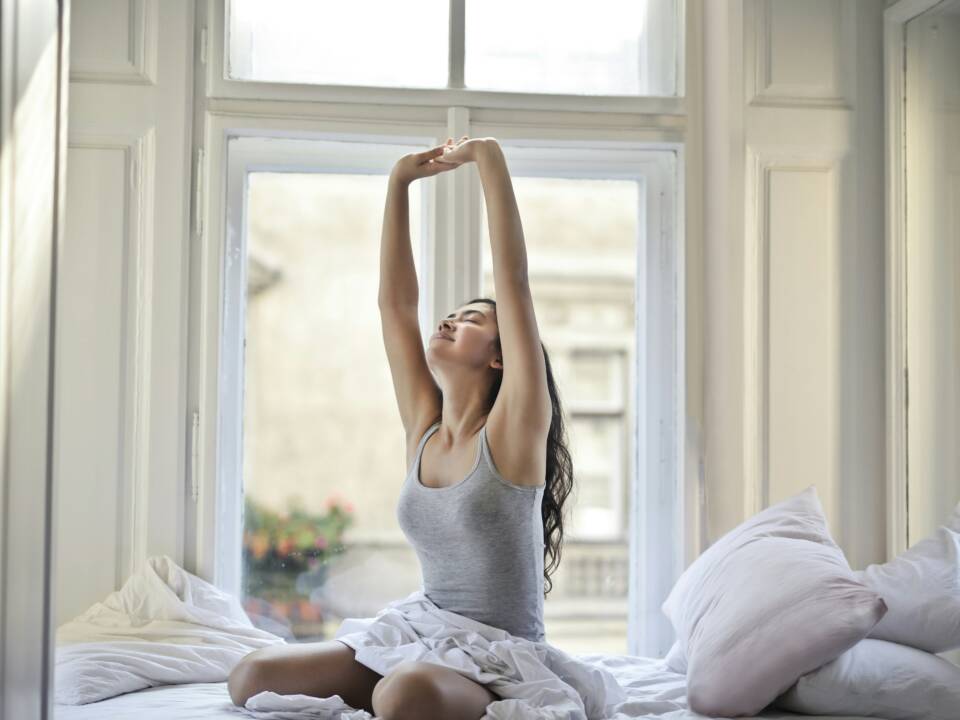
While many of us roll out of bed at the sound of our alarm and immediately grab our phones, head to the coffee maker, and/or rally the kids to get ready for school, carving out just a few minutes for yourself could dramatically change the course of your day and help you sleep better at night.
Intrigued? On Thursday’s show, Megyn was joined by Gary Brecka, founder of The Ultimate Human, to discuss the two-step A.M. ritual he swears by that won’t cost you a penny.
Proof of Concept
If you are not sleeping as well as you would like and your days feel like a slog, Brecka’s routine may be just what you need. When he last joined Megyn in December, he explained why sleep, diet, and exercise are crucial for longevity. You can check out that discussion here.
But how you show up for yourself through fitness, nutrition, and rest have a lot to do with how you are feeling at the start of and throughout the day. Having a simple, consistent routine is key, and the proof, he says, is in the pudding.
“The thing about this routine is that it’s easy. It’s portable. You can do it anywhere in the world. I’ve proven it a number of times by sharing my sleep scores on Instagram,” Brecka shared. “Last year… I did 14 cities in 18 days and was able to maintain 88 percent and higher sleep scores, even though I was changing time zones every day for 14 days.”
With that in mind, here is how Brecka starts his day:
#1 Find the Light
Within 30 minutes of waking each day, Brecka shared that he makes his way “outside into natural sunlight.” The mind-body benefits of sunlight, he said, are highly underrated and most effectively enjoyed via direct exposure.
“I’m not talking about through a window. I’m not talking about through your drapes. I’m talking about exposing your eyes to natural sunlight,” he said. “The one thing that you can do that is absolutely free to ensure that you get a good night’s sleep tonight is get sunlight in your eyes this morning.”
Brecka said the sunlight helps set your circadian cycle (i.e. your body’s internal biological clock), which is crucial for both sleep and longevity.
“What is so important about circadian rhythm is that this is what governs your menstrual cycle in the female. This is what governs your sleep and wake cycle in all human beings,” he explained. “When your cortisol rises, when your melatonin calms down, this actually governs your digestive tract. It actually sends signals to your digestive tract that you’re awake and peristalsis can begin, which is why most people don’t use the restroom and have a bowel movement at night. They usually have it first thing in the morning.”
And if you are thinking it is too cold or too cloudy to partake in such an exercise, think again. “I realize people live in cold climates; they live in dark climates. This light does penetrate through the clouds, so it doesn’t matter if it’s overcast. Get outside in sunlight,” Brecka said.
#2 Just Breathe
Obviously, if you have gotten out of bed and gone outdoors, you are breathing. But Brecka uses his time outside to do conscious breathwork that helps sustain him throughout the day. “I do three rounds of 30 obnoxiously deep breaths and, at the end of each round of deep breaths, I do a prolonged breath hold,” he revealed.
As he explained, finishing with the extended breath hold allows carbon dioxide to build up in bloodstream. “Carbon dioxide is the main vasodilator in the human body. The reason why we get vascular when we go to the gym and exercise is because of the CO2 going back to the lung, and so we want to dilate that vasculature first thing in the morning,” Brecka noted.
For those who are new to practice, Brecka recommends starting with five breaths and working your way up from there. “Do three rounds of five to 10 to 30 deep breaths with an extended breath hold in between,” he shared.
The science, he said, is clear regardless of your starting point. “If you really want to be blown away by what breathwork can do to the human body – regulate the immune system, tap into our autonomic nervous system – just watch the documentary on Wim Hof called The Iceman and you will become a believer,” Brecka said.
Hof is an extreme athlete from Holland who is renowned for his ability to withstand sub-zero temperatures through – you guessed it – controlling his breathing. He has climbed Mount Kilimanjaro in shorts, run a half marathon above the Arctic Circle barefoot, and stood in a container filled with ice cubes for almost two hours among other frigid feats.
While your goals might be less ‘survive Antarctica in a bikini’ and more ‘survive the carpool lane, a full day’s work, and maybe have time for a workout,’ Brecka said the benefits remain the same.
“If you do that consistently for seven days, you will never miss another day. It will become your new drug of choice because nothing will make you feel better for longer,” he promised. “[It] improves your mood, improves your emotional state, gets oxygen to our tissues, gets our digestive tract going, spikes our cortisol, reduces our melatonin, and sets us up for a great night’s sleep at night.”
If You’re an Earlier Riser…
Now, you may be thinking this sounds simple enough, but then you realize you wake up before the sun rises? Brecka has a solution. “The rule is the same. If you can’t get into sunlight within the first half hour because you’re waking up too early, then, after you drop the kids off at school, spend eight minutes outside, facing the sun, [and] allow the sunlight to hit your skin,” he said.
“Sunlight has wavelengths – they’re constant-on wavelengths – that pass through your eyes and they trigger very specific activities in the brain,” Brecka continued. “One of which is to tell the suprachiasmatic nucleus, this master puppeteer, that it’s morning, it’s time to raise my cortisol, it’s time to drop my melatonin, and it puts it onto a very good cycle.”
The Takeaway
In many ways, this “very simple” routine is a return to basics. “We used to sleep and wake with the sun. We are so disconnected from the cycle of Mother Earth now, and our schedules are so discombobulated. Sometimes we get up at 6am, sometimes 9am, sometimes 4:30 depending on whether or not we have a flight. We got to get the kids to school, or it’s a weekend and we’re going to ‘catch up’ on our sleep,” Brecka noted.
While we might not be able to change the timing of our hectic lives, we can create stability in the chaos with a simple commitment. “Our bodies are creatures of habit. They crave routine. When you want your body to trust you, you do the same thing at the same time every day,” Brecka emphasized.
“Give it some consistency, something that when you’re traveling, or when you’re in a different time zone, or when you’re staying in a different sleep environment – you’re at a hotel, you’re at an in-laws’ house – something that your body can cue into to know this is time to wake up,” he concluded. “Spend a few minutes outside; do a few rounds of breath work… Then, go back inside and tell me how good you feel when you start your day.”
You can check out Megyn’s full interview with Brecka by tuning in to episode 1,361 on YouTube, Apple Podcasts, or wherever you like to listen. And don’t forget that you can catch The Megyn Kelly Show live on SiriusXM’s The Megyn Kelly Channel (channel 111) weekdays from 12pm to 2pm ET.