

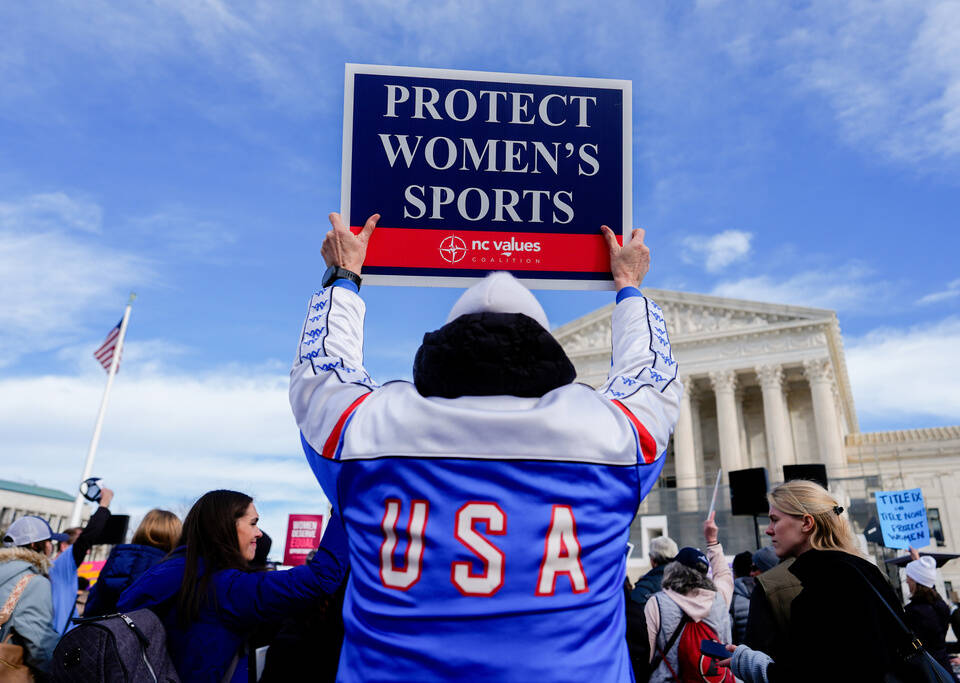
In a landmark ruling, the U.S. Supreme Court ruled states can bar biological boys and men from competing in girls’ and women’s sports.
The 6-3 decision in West Virginia v. B.P.J. came down along ideological lines, and while the case specifically involved laws in West Virginia and Idaho, the ruling has implications for 25 other states with similar restrictions.
Writing for the majority, Justice Brett Kavanaugh made clear “the Constitution and Title IX do not require an overhaul of women’s and girls’ sports throughout America.” In a concurring opinion, Justice Clarence Thomas went even further.
“A man does not have a legal right to compete against women just because he believes that he is a woman,” Thomas wrote. “Because ‘gender dysphoria’ is a mutable mental state that is the object of psychiatric treatment, it does not resemble the immutable characteristics on the basis of which our precedents have applied heightened scrutiny – race, sex, or national origin.”
“To use language to obscure reality – to show ‘indifference regarding the truth’ – is to lie to the public and cease to treat our fellow citizens ‘as equals,'” he concluded.
The Landmark Decision
On Tuesday’s Megyn Kelly Show, Megyn shared that she “teared up” when she saw the decision because of how hard-fought the battle to protect women’s sports and spaces has been. “So many people have worked so hard to make this happen, and, today, reason prevailed. The protection of girls and young women is insured now, at least for those 27 states that have passed bans disallowing biological boys to participate in their sports,” she proclaimed.
What’s more? Megyn said Thomas’ explanation of “immutable characteristics” is hugely consequential. “He is saying transgenderism is not an immutable characteristic like your skin color, so it is not going to get this heightened scrutiny when it is treated as it has been by these bans. It is not the be all end all,” she explained. “The high court is not going to bend over backward to be protective of people who claim to have a status because it’s not immutable. It’s mutable. You can mute it. Ask [detransitioner] Chloe Cole… It’s a social contagion and a psychiatric illness, and it… actually does get reversed all the time.”
Alliance Defending Freedom president and chief counsel Kristen Waggoner, who took this issue all the way to the Supreme Court, agreed. “Thomas’ line about it not being an immutable characteristic is huge because after [Bostock v. Clayton County (2020)], in which the high court said, under Title VII, transgender people have a right… not to be not hired… or fired based on their transgenderism, we all worried,” she recalled. “If it’s getting treated like race or sex or disability or age, that’s a whole different kettle of fish. Then, you can’t ‘discriminate’ against transgenderism in any way, which would include the sports field, our locker rooms, and so on.”
While Waggoner said trans activists have been using the Bostock decision as a way to push for such protections, she believes this decision “makes clear Bostock is extremely limited.” And having such declarations in writing, she said, is crucial.
“We have a number of justices that have already recognized this in writing, and we need to continue to ensure that we get that final decision by the Supreme Court,” Waggoner noted. “It has, year after year, rejected these arguments, but these are the arguments that radical activists are pushing forward… and we have to keep defending them and ensuring that our girls and our boys are not told they’re born in the wrong body because there are real world consequences to that.”
Next Steps
Even more promising is the effect Waggoner believes this ruling can have outside of just the 27 states that have laws prohibiting the participation of ‘trans’ athletes in women’s and girl’s sports.
“I am so excited about applying this decision in the other states. The court essentially said biology matters; it’s a real thing; the law can reflect it; sex-based categories are important. In fact, the court said it’s vitally important,” she said. “So, we are coming for the 23 states [that don’t have bans]. We already have cases in several of those states.”
But she said the legal challenges could go even further. “The court’s decision, the logic of it, is that women and girls are experiencing the cost of this and that, under Title IX federal statute, there is a right of girls to insist that they have equal opportunities on the playing field, and I think that the logic of it is going to extend to our rights in the locker rooms, in the dorm rooms, in the showers,” Waggoner posited.
“The court says we’re limiting this to whether states may make these distinctions, but the rationale behind it, the logic that the court is using, is saying there are inherent physical differences between men and women, between boys and girls, and, where those differences matter, states are right to enforce them,” she explained.
That means the next wave of work on this issue has only just begun. “The court also said that under Title IX, there is a right of girls to have equal opportunities on the playing field – and those just aren’t like, oh, we have to have separate teams; but qualitatively the same opportunities, quantitatively the same opportunities,” Waggoner noted. “So, under Title IV, which also is going to apply in the context of the privacy and safety under these statutes, we are going to drive those decisions home.”
You can check out Megyn’s full interview with Waggoner by tuning in to episode 1,350 on YouTube, Apple Podcasts, or wherever you like to listen. And don’t forget that you can catch The Megyn Kelly Show live on SiriusXM’s The Megyn Kelly Channel (channel 111) weekdays from 12pm to 2pm ET.