

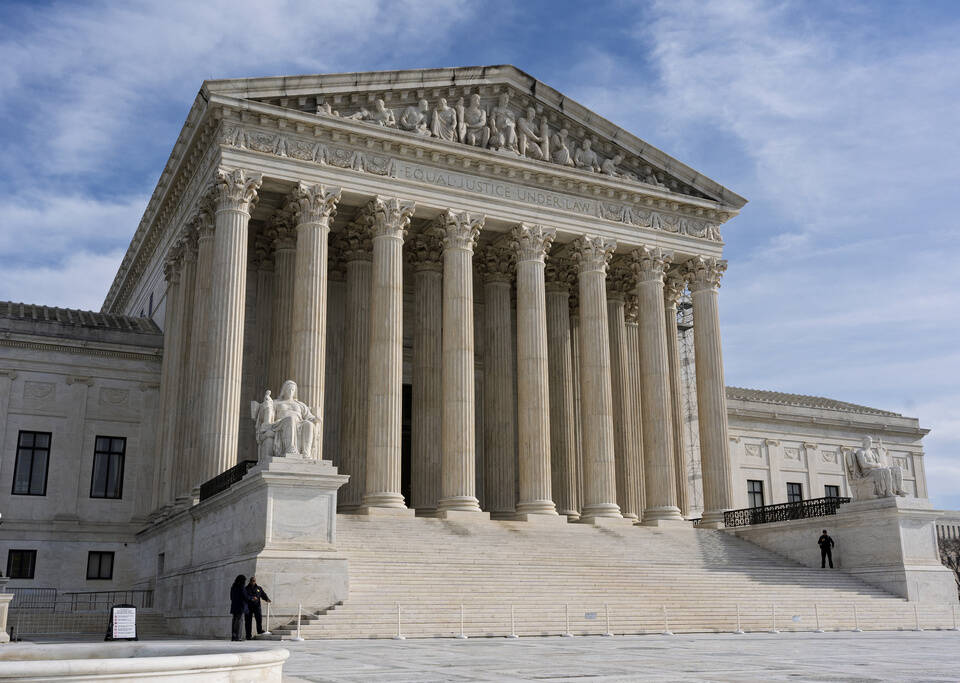
The U.S. Supreme Court handed down to major rulings on Thursday that amount to two major wins for the Trump administration’s immigration agenda.
Border Dispute
The first case, Mullin v. Al Otro Lado, was decided in a 6-3 vote along ideological lines and ruled that the federal government can turn away migrants seeking asylum before they have actually crossed the border.
The Immigration and Nationality Act allows an immigrant who “arrives in the United States” to apply for asylum. The question before the court was whether an immigrant “arrives” in the country when he or she crosses the border or when the person is standing at the border in Mexico and engaging with U.S. agents.
The court sided with the Justice Department position that a migrant does not “arrive” in the United States until he or she is actually in the country. In the majority opinion, Justice Samuel Alito likened it to someone showing up on your doorstep. “A guest does not arrive in a house when he knocks on the front door,” he wrote.
Joined by fellow liberal Justices Elena Kagan and Ketanji Brown Jackson, Justice Sonia Sotomayor argued in the dissent that the majority did not properly consider the context of the law. “The majority ignores the statutory context and history, not to mention the longstanding position of the Executive Branch, all of which show that any noncitizen arriving at our doorstep and seeking admission must be inspected and allowed to apply for asylum, regardless of whether her foot has crossed the threshold,” she wrote.
TPS Ruling
In a case that is likely to be even more consequential, the same 6-3 majority sided with the Trump administration in its effort to end Temporary Protected Status (TPS) for Haitian and Syrian immigrants in Mullin v. Doe.
The decision clears the way for the administration to deport about 350,000 Haitians and over 6,000 Syrians – and is likely to have implications for the approximately one million individuals living in the U.S. under TPS from other countries.
Passed by Congress in 1990, the TPS program gives the Department of Homeland Security the power to designate another country’s citizens eligible to live and work in the U.S. because they cannot safely return to their homeland due to a natural disaster, war, or other “extraordinary and temporary” conditions.
TPS designations were designed to be for specific periods of time – hence the word “temporary” – but the laws for the status to be extended. The Obama administration granted Haitians TPS in 2010 following the country’s devastating earthquake, while Syrians received the designation in 2012 due to civil war.
TPS for both countries was extended multiple times, until the Trump administration attempted to end it for both countries last year. The move was blocked by lower courts that found that the administration did not follow the proper procedures to end the program for Haitians and Syrians. In the Haiti case, in particular, it was alleged that the decision was possibly motivated by racial animus.
The Trump administration appealed the case to the Supreme Court and won. The majority ruled judges are prohibited from reviewing Executive Branch determinations on TPS when constitutional issues aren’t involved.
“A provision of the TPS statute… provides: ‘There is no judicial review of any determination of the [Secretary of Homeland Security] with respect to the designation, or termination or extension of a designation, of a foreign state under this subsection.’ This text is clear, and its plain meaning is very broad,” Justice Alito wrote in the majority opinion.
He also rejected the racial arguments. “None of the cited statements by either the President or the Secretary was overtly racial, and in substance all expressed policy views that could rest on race-neutral justifications,” Alito added.
In the dissent, Justice Kagan argued judges can review if the administration followed the proper procedure to end TPS and that her colleagues in the majority ignored evidence of the Trump administration’s racism.
“The majority claims to see no evidence that race played any role in the Haiti decision. But the evidence is there, plain to see, in the President’s statements, which the majority (and for that matter, his own lawyers) cannot even bear to repeat,” Kagan wrote.
Megyn’s Take
On Thursday’s show, Megyn reacted to the Supreme Court’s decision in both cases and debunked the hysterical claims being made by the left and media in the wake of the rulings. Watch:
You can check out Megyn’s full analysis by tuning in to episode 1,347 on YouTube, Apple Podcasts, or wherever you like to listen. And don’t forget that you can catch The Megyn Kelly Show live on SiriusXM’s The Megyn Kelly Channel (channel 111) weekdays from 12pm to 2pm ET.