

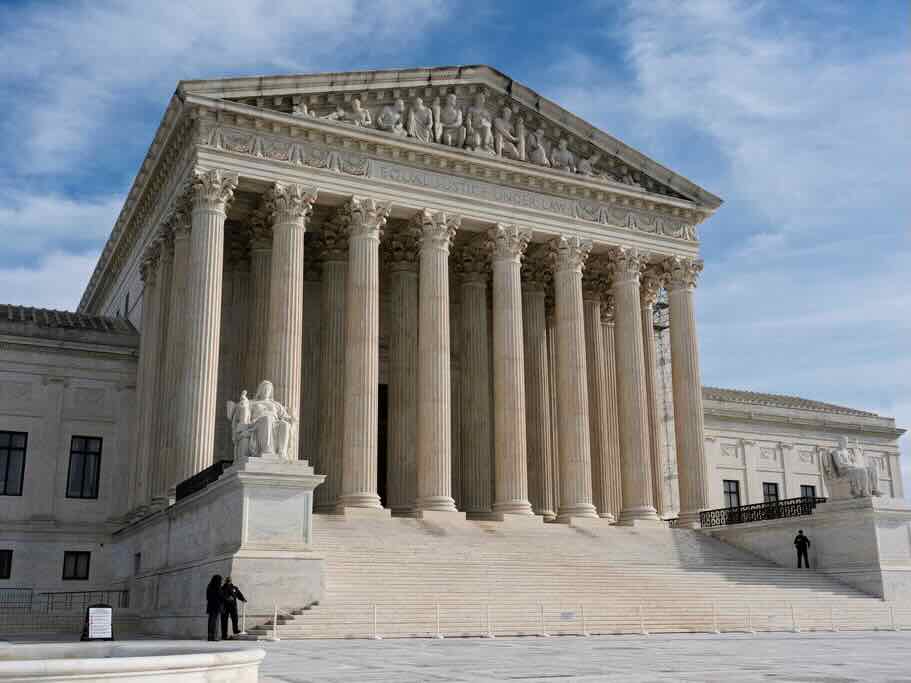
The Supreme Court heard oral arguments Monday in a case that could reshape how states handle mail-in ballots – specifically, whether ballots postmarked by Election Day but arriving later can still be counted.
As reported on Tuesday’s AM Update, at issue is a Mississippi law adopted in 2020 during the COVID pandemic that allows mail-in ballots to be counted as long as they are postmarked by Election Day and then received within five business days after.
Four years later, the Republican National Committee, the Mississippi Republican Party, a voter, and a county election official challenged that law, arguing it conflicts with federal statute setting a single national Election Day (i.e. the Tuesday after the first Monday in November). A separate lawsuit by the Libertarian Party of Mississippi eventually combined with the Republicans’ case.
The Constitution grants states authority over the “times, places, and manner” of elections, but it also gives Congress the power to override those rules. Mississippi argues that an election occurs when voters cast their ballots not when officials receive or count them, so timely postmarking satisfies federal law. The challengers argue Election Day is when officials receive the ballots, meaning the Magnolia State’s mail-in policy is in violation of federal law.
The Arguments
The case was appealed all the way up to the Supreme Court, where, after more than two hours of arguments, several of the more conservative justices appeared skeptical of Mississippi’s position.
Right out of the gate, Justices Clarence Thomas, John Roberts, and Amy Coney Barrett pressed Mississippi Solicitor General Scott Stewart with a rapid-fire round of questions about the extent of the law. Justice Samuel Alito, meanwhile, zeroed in on the meaning of the term “Election Day.”
“We have lots of phrases that involve two words, the last of which, the second of which is ‘day’ –Labor Day, Memorial Day, George Washington’s birthday, Independence Day, birthday, and Election Day – and they’re all particular days,” he said. “So, if we start with that, if I have nothing more to look at than the phrase ‘Election Day,’ I think this is the day in which everything is going to take place, or almost everything.”
President Donald Trump has long been critical of mail-in balloting because he believes it opens the door to fraud and undermines confidence in the integrity of the election system. That concern was echoed during arguments with Justices Alito and Brett Kavanaugh raising questions about delayed ballot counts. Mississippi’s solicitor general maintained that there is little evidence that late-arriving ballots lead to fraud.
Liberal Justice Elena Kagan questioned whether the RNC’s argument could also call early voting into question. “You’re basically saying there are two things that have to happen and they have to happen on Election Day, and it’s… the casting of the vote and the receipt of the vote, and both of those things have to be on Election Day,” she said. “And just like a normal person says, ‘Okay, well, when I early vote, I’m not doing that on that first Tuesday.'”
Arguing for the challengers, Paul Clement said early voting is different because those votes are still finalized on Election Day.
The Analysis
More than a dozen states allow for late-arriving mail-in ballots to be counted if they are postmarked by Election Day, meaning the court’s decision could have ripple effects well beyond Mississippi. AM Update spoke with America First Policy Institute’s Director for Election Integrity Thomas Lane about the arguments and what is at stake.
He described how a ruling striking down the Mississippi law could affect elections in other states with similar laws:
“If this case is resolved so that the ballot receipt deadline past five business days is struck down… this question was was asked: Hey, does this affect primary elections? Is it just the general election in November? And while Mississippi’s law applies to all of their elections – primary elections, recall elections, the general election in November – what is at hand in that issue before the court is just the federal general election in November. So for primary elections that are coming up or, in some states, have already gone by, this ruling would not effect them. But what it does affect those 18 states and the District of Columbia is in November.”
One reason this case is unusual is because it is not a deep blue state like California or New York defending late-arriving ballots, but rather a reliably red state, Mississippi, on the opposite side of President Trump, the RNC, and many Republicans. Lane offered a theory as to why:
“When the RNC was looking at challenging the post-receipt deadline… if you go and you sue in Illinois or you go and sue in New York, you’re not going to… have a favorable decision in those lower courts, and you’re going to hope that you can appeal all the way up to the Supreme Court. But what I think happened here is the RNC saw that Mississippi is a very favorable venue for this…
Mississippi’s Solicitor General [Scott G. Stewart], who argued for Mississippi here, actually was the lawyer who argued the Dobbs case that overturned Roe v. Wade. So, in very many conservative circles, this attorney… is a friend. And so it is odd that you have a red state… on the opposite side of the administration or, in my view, a very common sense practice and policy of having Election Day be Election Day… But I think, in the end, no matter how formidable the argument was from Mississippi, their law will be overturned.”
To that point, Lane believes the conservative members of the court are set to side with the challengers. “If I were to predict how this would go down, I think this is a very easy five- and up to six-vote majority for striking down Mississippi’s law of receiving ballots five days after the election,” he said.
An opinion is expected by late June.
You can get all the day’s headlines by tuning into the AM Update with Megyn Kelly on YouTube, Apple Podcasts, or wherever you like to listen. And don’t forget that you can catch AM Update on SiriusXM’s The Megyn Kelly Channel (channel 111).