

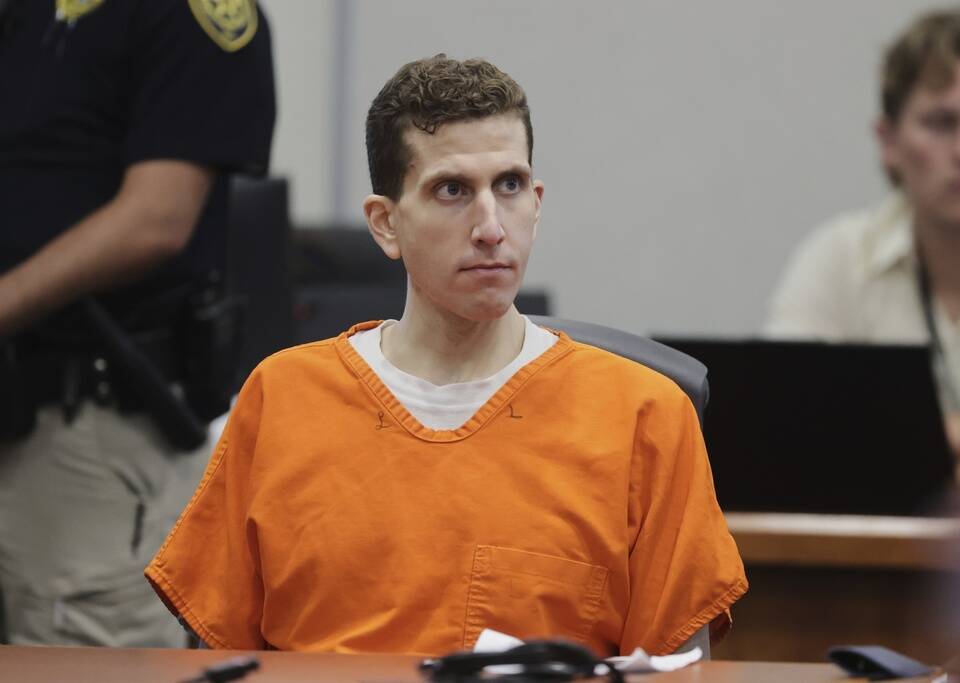
Bryan Kohberger is serving four consecutive life sentences in an Idaho prison for the stabbing deaths of University of Idaho students Kaylee Goncalves, Madison Mogen, Xana Kernodle, and Ethan Chapin on November 13, 2022. But was he the lone assailant?
New questions are being raised about whether Kohberger acted alone after unsealed court filings revealed more horrifying details about the final moments of the victims’ lives. Autopsy findings showed the students were collectively stabbed at least 150 times, and a forensic criminologist hired by Kohberger’s defense team was reportedly poised to argue that “at least two suspects were involved in this attack” after reviewing those results.
And he is not the only person exploring that possibility. Journalist Howard Blum has been covering this case from the beginning, and now he is raising the unsettling theory that Kohberger may have had help. He joined Megyn on Friday’s show to discuss what doesn’t add up and where the case goes from here.
The Theory
Blum wrote a bestselling book about the Idaho murders case, When the Night Comes Falling: A Requiem for the Idaho Student Murders, and said he is “not a conspiracy theorist,” but he believes there was a lot about the Idaho murders that he “didn’t quite understand.”
For starters, Blum said the case came to an abrupt and – as Megyn put it at the time – “unsatisfying” end when the prosecution allowed Kohberger to cop a plea to avoid the death penalty. “It was settled very quickly over the course of a weekend,” he noted. “The case was sort of wrapped up after two and a half years of combative, vitriolic wrangling between the prosecution and the defense.”
And while he believes Kohberger was involved in the killings, he isn’t sure that is the whole story. “When the case ended, I thought, ‘Well, they’ve got the right man.’ And I still believe Kohberger is guilty,” he shared. “But I think there is a larger story to tell when you look at the evidence that is suddenly being released.”
The Evidence
That evidence includes gruesome and disturbing images of the crime scene that were posted for a brief time before being taken down by law enforcement. The pictures show just how much blood and gore there was in the home in the wake of the murders, and Blum questioned how that tracks with what was previously known about the sequence of events.
“The scenario for the murders, according to the police, is that the murders occurred between 4:07am and 4:20am, 13 minutes. I think that scenario is a little overly generous. I would suggest that the murders occurred in just nine minutes because Kohberger had to then leave the house, go up the hill, take off his bloody suit,” he explained. “So between nine and 13 minutes the murders occurred, and, as you said, [there were] 150 stab wounds. This was a very brutal, vicious attack. Could one man have gone through two floors of the house and, with just nine minutes or 13 minutes… committed all these murders?”
And then there is the fact that both the defense and prosecution seemed to agree that there may have been more than one murder weapon. Newly unsealed court documents obtained by People reveal Dr. Brent Tarvey, the forensic criminologist hired by Kohberger’s legal team, believed Goncalves, in particular, was attacked with two different weapons and suffered two different forms of wounds.
Tarvey used this finding as part of his argument that “at least two suspects were involved in this attack.” Prosecutors did not deny the existence of a second weapon, instead responding that “a single perpetrator can certainly use more than one weapon and can use multiple types of lethal force.”
There is also the question of how one person could have attacked both Chapin and Kernodle at the same time, as the autopsies suggest. “It is not reasonable to think that Ethan would have remained in his bed after waking up or being awake while Xana was being attacked in front of him,” Tarvey wrote in his report. “This evidence and context begin to suggest the existence of a second attacker.”
The prosecution, however, pushed back on the claim, responding: “One assailant could contain two people in close proximity to each other, especially if the assailant is armed.”
Perhaps most interesting is what Kohberger reportedly said to police when he was arrested at his parents’ Pennsylvania home some six weeks after the murders. “On the night of Kohberger’s arrest… he was put up in zip ties… by the police… [and] taken out to a state trooper’s car,” Blum noted. “He was sitting put in the back seat, and the first thing he says to the state trooper is: ‘Was anyone else arrested?'”
“At the time, no one really paid too much attention to this. We thought he was being the dutiful son, concerned about his parents or his sister,” he added. “But now, in retrospect, when you look at all the other aspects of the case, when you look at what occurred that night, whether one man could have done it, this question has a more ominous echo. Was anyone else arrested? It raises the possibility that someone else is out there right now.”
Lingering Questions
That coupled with lingering doubts as a result of the DNA of other people discovered at the crime scene, the lack of blood found on anything associated with Kohberger (could he have actually been an accomplice?), and the ever-changing stories of the surviving roommates is what has led many, including Blum, to seek more information.
“Let’s emphasize that this is a hypothesis, [but] it is something, I think, worth exploring,” Blum said. “I’m not saying for sure that Kohberger had an accomplice, but enough questions have been raised for me to want to dig deeper into this.”
You can check out Megyn’s full interview with Blum by tuning in to episode 1,242 on YouTube, Apple Podcasts, or wherever you like to listen. And don’t forget that you can catch The Megyn Kelly Show live on SiriusXM’s The Megyn Kelly Channel (channel 111) weekdays from 12pm to 2pm ET.