

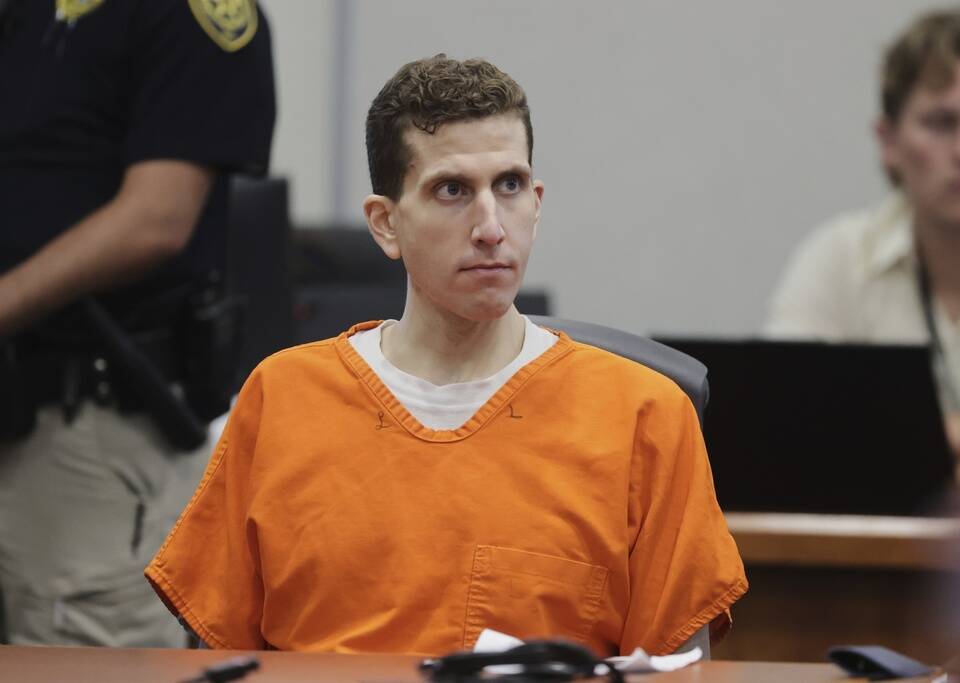
The family of convicted quadruple murderer Bryan Kohberger is speaking publicly for the first time.
Six months after her brother pleaded guilty to all counts against him – including four counts of first degree murder for the 2022 stabbing deaths of University of Idaho students Ethan Chapin, Xana Kernodle, Madison Mogen, and Kaylee Goncalves – as part of a highly controversial plea deal to avoid the death penalty, Melissa “Mel” Kohberger gave an interview to The New York Times to share her family’s perspective.
While the piece contained, in Megyn’s view, “some interesting background,” she said it amounted more to an image rehab exercise than the hard-hitting interview it needed to be. On Tuesday’s show, she was joined by Glenn Greenwald, host of Rumble’s System Update, to discuss the article and how the Times whitewashed key details.
The Interview
Mel Kohberger was interviewed by New York Times national investigative correspondent Mike Baker for the lengthy piece, which also included photographs of her wearing a goth-style shirt with electric blue hair and heavy eye makeup. She said she was about to begin a new job as a mental health therapist in late 2022, but intense inquiries following her brother’s arrest led to her agreeing to leave the post.
Mel revealed that when she first found out about the Idaho murders, she felt a sense of alarm that her brother lived just 15 minutes from the scene of the grisly crime with the killer still on the loose. She recalled telling her brother, “Bryan, you are running outside and this psycho killer is on the loose,” unaware that the “psycho killer” was actually her brother Bryan. Subsequently, she said she could only remember Bryan bringing up the case one other time and it was a mention that investigators were searching for the killer.
Mel told the Times that she and her siblings were raised with lessons rooted in their mother’s Catholic faith. They apparently grew up reading books like Little House on the Prairie, and she said she never saw her brother behave violently.
While that is one of the reasons the family has found the ordeal so disorienting, Mel also described her younger brother’s struggles with his weight and persistent bullying as a teen. She called his personality “standoffish” and noted the family now thinks it was related to autism. They once believed he was on a path to an early death due, in part, to a heroin addiction that led Bryan to steal her phone to buy more drugs.
She told the Times that the family was hopeful Bryan was on a better trajectory after addiction treatment and acceptance into a PhD program at Washington State University, where he studied criminology.
Mel said they previously declined to give public statements about the murders out of respect for the victims and their families during the legal process, but she said her mother, MaryAnn Kohberger, prays for them daily and she has personally put Chapin, Kernodle, Mogen, and Goncalves’ birthdays into her digital calendar so she will be reminded of them.
While she admitted that her family felt grief that Bryan, who is now serving four consecutive life sentences at the Idaho Maximum Security Institution, could not be with them over the holidays, Mel said she also thought of the victims’ families and the pain they must be feeling. She was careful to say that there is only one set of victims in this case and she is not on the list.
The Red Flag
The article seemingly brushed past what, if any, suspicions Mel and her relatives may have had despite the fact that there has been extensive reporting on the topic by Howard Blum and others.
According to the Times, Mel knew her brother drove a white Hyundai Elantra back from school and she “briefly wondered” if authorities were looking for the same model. She was allegedly relieved of her fears once she found out his was a 2015 make and investigators were looking for model years 2011 to 2013.
“Now, that right there is such an obvious lie,” Megyn said. “If your mind goes to ‘my brother might be the homicidal maniac who took those four lives, but, technically, his white Elantra was built two years after the years they’re looking for,’ I’m calling bullshit on you. If you placed your sibling in the field of possible killers, you’re actually not relieved that maybe the cut off was 2013, which, by the way, they later updated.”
Greenwald agreed. “I have a brother and I couldn’t imagine ever remotely – even for like a fleeting second – considering the possibility that he is a serial killer,” he said. “And then, if I were actually in a realm where I was considering that possibility… the idea that, ‘Oh, I’m going to exonerate him only because the car that he was driving was out of the range by about a year’? Once you’re down that road, you’re well beyond where anybody would ever be. That would be a pretty big red flag.”
What’s Missing
Also left unsaid by Baker and the Times was, as Blum reported in his book When the Night Comes Falling, the allegation that Mel confronted her father, Michael Kohberger, with her fears that Bryan was involved in the murders. She reportedly witnessed her brother engaging in odd behavior, such as wearing rubber gloves and placing his personal garbage into Ziploc bags before disposing of them in a neighbor’s trash can in the days leading up to his arrest.
Additionally, the Times failed to note that Bryan’s phone records show he called his mother within an hour of when the murders occurred and spoke to her another four times after in conversations totaling over three hours in length.
“None of [that] is mentioned in this rehabilitative puff piece in The New York Times that did absolutely no kicking of the sister’s story or tires,” Megyn said. “It was a journalistic fail where this guy obviously let himself get used by a young woman with some psychological training on how to manipulate people as it turns out, according to me. And this had no business appearing in a ‘paper of record’ like the Times.”
Media Malpractice
In Greenwald’s view, this article illustrates “one of the things that is most dangerous” to journalism. “This is a big scoop, right? This is the sister of this serial killer in a case that has gotten major attention,” he explained. “He is kind of this enigma and mystery. He has never spoken… No one understands why he did what he did… And now the sister is speaking for the first time. It’s a big benefit to the reporter at The New York Times to get the story.”
But in an effort to “get the story,” Greenwald said some journalists fall into a trap. “One of the problems that bad journalists fall into… is that when you have a source who is giving you an important story that can help your career, it is very tempting to start trying to almost become their advocate, to take their side, to almost say, ‘If you give me this story, I will help you as well,'” he explained. “And it becomes this quid pro quo, where now the journalist isn’t doing journalism by interviewing this source. The journalist hat is out the window because they are so grateful they got the story.”
While Greenwald said he didn’t follow the intricacies of the Idaho murders case, he said it was clear even to him that major questions were not addressed by the Times. “I did look at this article a few days ago when it came out… [and] it was my impression there were so many aspects of the story… [and] so many obvious follow-ups that just aren’t in there,” he concluded. “I wasn’t even aware that there was other reporting that they should have been confronted with, but that, I do think, is something that happens quite often and it’s a big problem with journalism.”
You can check out Megyn’s full interview with Greenwald by tuning in to episode 1,224 on YouTube, Apple Podcasts, or wherever you like to listen. And don’t forget that you can catch The Megyn Kelly Show live on SiriusXM’s The Megyn Kelly Channel (channel 111) weekdays from 12pm to 2pm ET.