

In a surprise 5-4 decision, the U.S. Supreme Court upheld a Mississippi law that allows absentee ballots to continue being counted after Election Day so long as certain postmark and delivery conditions are met.
The Case
The case, Watson v. Republican National Committee, was an unusual one from the start because it pitted a red state, Mississippi, against Republican plaintiffs. At issue: A Mississippi law adopted during the COVID pandemic in 2020 that allows mail-in ballots to be counted as long as they are postmarked by Election Day and then received within five business days after.
Four years later, the Republican National Committee, the Mississippi Republican Party, a voter, and a county election official challenged that law, arguing it conflicts with federal statute setting a single national Election Day (i.e. the Tuesday after the first Monday in November). A separate lawsuit by the Libertarian Party of Mississippi eventually combined with the GOP’s case.
While the Constitution grants states authority over the “times, places, and manner” of elections, it also gives Congress the power to override those rules. Mississippi argued an election occurs when voters cast their ballots not when officials receive or count them, so timely postmarking satisfies federal law. The challengers argued Election Day is when officials receive the ballots, meaning the Magnolia State’s mail-in policy violates of federal law.
The Decision
The case was appealed all the way up to the Supreme Court, where, after more than two hours of arguments in March, many court-watchers believed the more conservative justices appeared skeptical of Mississippi’s position.
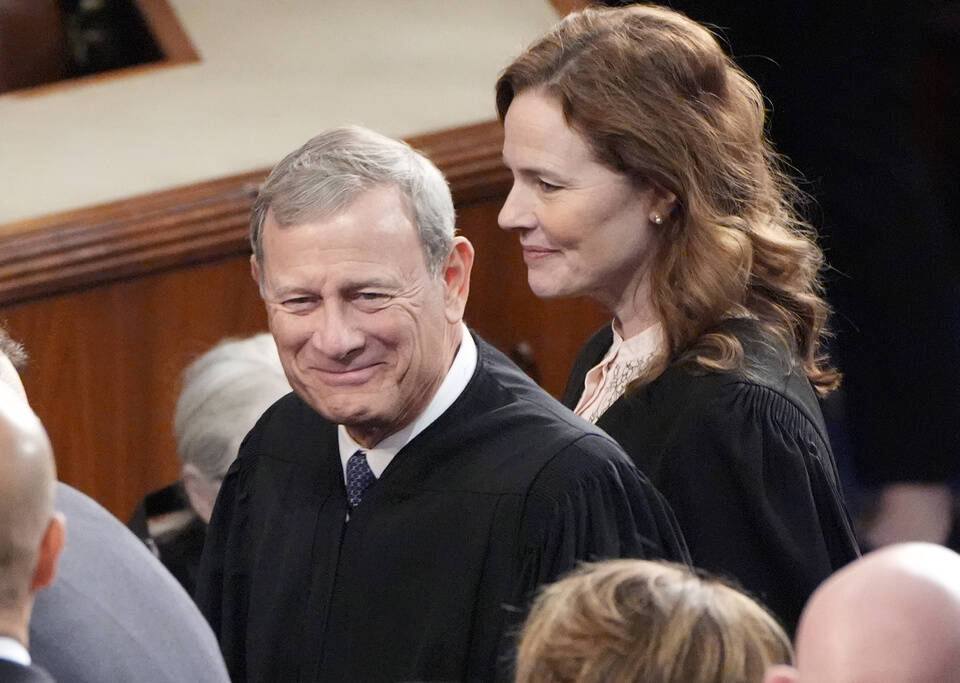
But that did not ultimately prove to be true. Chief Justice John Roberts and Justice Amy Coney Barrett joined the three liberals in the majority with Barrett penning the opinion.
In writing for the majority, Barrett rejected the argument that federal law defines an ‘election’ as the day by which ballots must be both cast and received and, therefore, absentee votes received after Election Day should not be counted. “Election-day statutes do not set a deadline for ballot receipt, so they do not prevent Mississippi from counting ballots postmarked before election day yet received afterward,” she wrote.
Justice Samuel Alito, in a blistering dissent, disagreed. “Not only is today’s decision inconsistent with statutory text, legal context, historical practice, and precedent… it also threatens to produce lamentable consequences,” he wrote. “The majority’s holding spawns a slurry of troubling election-law questions and risks further undermining Americans’ confidence in election integrity.”
During oral arguments, Alito seemingly made the case that Election Day should be considered one single day. “We have lots of phrases that involve two words, the last of which, the second of which is ‘day’ – Labor Day, Memorial Day, George Washington’s birthday, Independence Day, birthday, and Election Day – and they’re all particular days,” he said at the time. “So, if we start with that, if I have nothing more to look at than the phrase ‘Election Day,’ I think this is the day in which everything is going to take place, or almost everything.”
The Fallout
The decision is expected to have a major impact in blue states, where elected officials often encourage residents to vote by mail and, in turn, cause votes to be counted days if not weeks after the election is over.
Case in point: The Los Angeles mayoral race earlier this month where Spencer Pratt dropped from second to third – thus missing out on the November general election – after progressive Councilwoman Nithya Raman saw her vote total surge in the days after the primary.
“[She] was in last position out there in that mayoral race and suddenly surged to first in jurisdictions that she had been… down in single digits… thanks to that mail-in vote,” Megyn noted on Monday’s Megyn Kelly Show. “Was it because her voters were just awfully silent about their love and support for her prior to Election Day, or could it have been shenanigans by these paid Democrat operatives exploiting the homeless and others to make sure that ballots came in late?”
According to The New York Times, there are similar absentee ballot laws in at least 18 other states and territories, including 2026 battleground districts in Nevada and California, which makes the decision all the more pertinent.
Reacting on Truth Social, President Donald Trump called the decision a “tremendous loss… concerning Voter’s Rights” and used it as an opportunity to advocate for the passage of the SAVE America Act, which would legally curtail the use of mail-in ballots.
Megyn’s guest, Article III Project founder Mike Davis, was similarly concerned about election integrity moving forward. “The effect of this Supreme Court ruling… is we’re going to have third-world elections,” he warned.
“‘Election Day’ does not mean ‘election day,'” he continued. “It means… when Democrats figure out how many votes they’re behind, they’re going to be able to go find those votes, fill out ballots, have their postal workers postmark those ballots, and then apparently election day – under Barrett’s rationale – is the number of days it takes for Democrats to steal the election.”
‘Turncoat’ Justices
Beyond the political ramifications of the ruling, Megyn took issue with “turncoats” Roberts and Barrett for siding with Justices Sonia Sotomayor, Elena Kagan, and Ketanji Brown Jackson in the case.
“When the libs have the majority on the Supreme Court, this doesn’t happen to them. The liberal justices know why they’re there, and they behave accordingly. They vote accordingly. It’s only the Republicans who become the wishy-washy institutionalists or the crossover votes,” she noted.
Megyn said the pair join a list of past justices nominated by Republican presidents, like Anthony Kennedy, Sandra Day O’Connor, and David Souter, “who completely jumped to the other side” once confirmed.
“Barrett and Roberts were turncoats on a really important one… She is constantly siding with the left, and John Roberts… is pursuing the wrong agenda as chief justice. He’s an ‘institutionalist meant to protect the Supreme Court’ – that’s not your job… in the actual decision making,” Megyn explained. “I can see in protecting the Supreme Court’s reputation and standing up for justices who are under attack… but you change your vote for that? I don’t know that that’s what he did here, but it’s definitely what he did in upholding Obamacare.”
“We are supposed to have 6-3 conservatives to libs, and today we only had four conservatives,” she added. “That is how we lost, because Roberts and Barrett jumped over to the liberal side and Barrett even wrote the court’s majority opinion.”
You can check out Megyn’s full interview with Davis by tuning in to episode 1,349 on YouTube, Apple Podcasts, or wherever you like to listen. And don’t forget that you can catch The Megyn Kelly Show live on SiriusXM’s The Megyn Kelly Channel (channel 111) weekdays from 12pm to 2pm ET.