

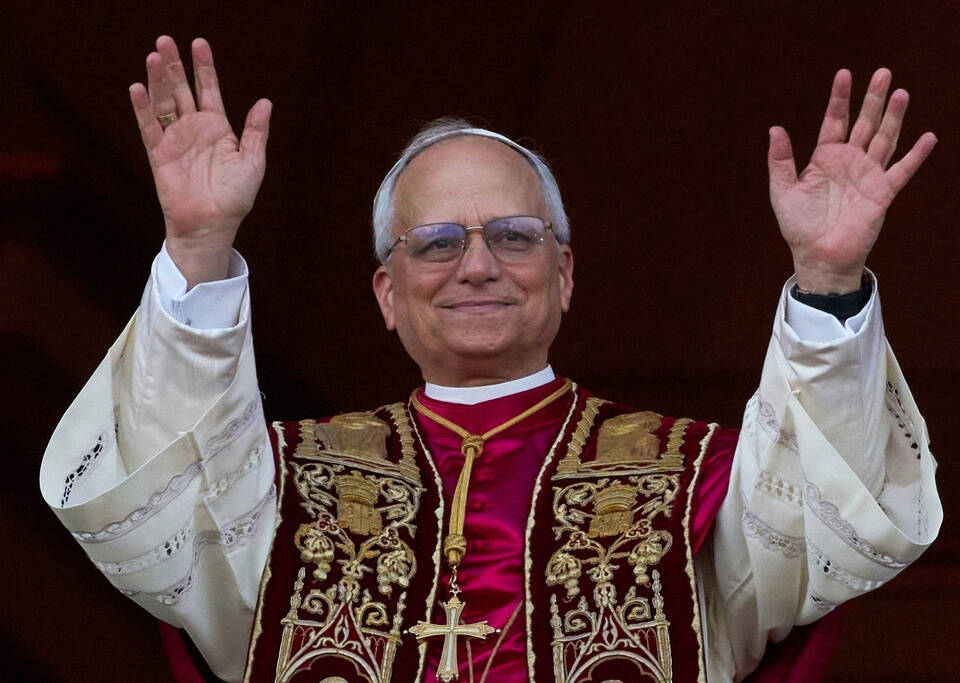
Pope Leo XIV released the first encyclical of his papacy on Monday, sounding the alarm on artificial intelligence and calling on global leaders to ensure the technology serves mankind – not the other way around.
The History
An encyclical is the papacy’s version of a policy paper and is meant to offer moral guidance and clarify Church doctrine in response to the defining questions of the age. As reported on Wednesday’s AM Update, this encyclical focused largely on AI.
Pope Leo took his papal name from Pope Pope Leo XIII, the pontiff who led the Catholic Church through the Industrial Revolution in the late nineteenth century when factories, mass labor, and rapid technological change transformed daily life.
Now, the pontiff argued the Church is facing another upheaval of comparable scale, this time driven by machines that do not merely assist human beings but increasingly shape decisions about work, war, truth, and what it means to be human.
“At key moments in history, the church is called to decipher the new things in the light of the gospel and the dignity of the human being,” Pope Leo told the crowd of cardinals, computer scientists, journalists, and diplomats gathered at the Vatican’s Synod Hall on Monday. “135 years ago, my venerable predecessor, Leo XIII, observed the situation of factory workers, their families uprooted, and new forms of poverty generated by rapid industrial transformation. He understood that the church could not remain distant.”
He believes the world is facing a similar situation now. “Today, we find ourselves facing a transformation of similar magnitude with perhaps even greater consequences,” the pontiff continued. “Artificial intelligence already touches many areas of our lives and affects decisions that shape human coexistence… Like the earlier Leo, I feel entrusted to look upon another huge transformation with eyes of faith, with lucidity of reason, with openness to mystery, and with cries of the poor and the earth resounding in my heart.”
Current Concerns
Concerns over AI have been echoed recently in the boos heard at college graduations around the country after several commencement speakers cast the technology as an unavoidable force in the world they are entering. Former Google CEO Eric Schmidt heard the chorus while addressing the University of Arizona earlier this month:
That unease also exists within the tech industry itself, where some of AI’s creators are now voicing a kind of Frankenstein fear and warning that what they have built may be advancing faster than its creators intended. That is a conversation Megyn had last month with Center for Humane Technology co-founder Tristan Harris in response to the shocking new AI documentary The AI Doc. You can watch that conversation in episode 1,306.
The Encyclical
On Monday, Pope Leo unveiled “Magnifica Humanitas,” or “Magnificent Humanity,” a roughly 42,300-word document addressed not only to Catholics but to “all people of good will.”
The document focuses on “safeguarding humanity at a time of transformation,” with concerns ranging from labor and human dignity to warfare, truth, power, and the common good.
One of the pontiff’s central warnings is against confusing imitation with humanity, noting that AI programs merely imitate certain functions of intelligence. “So-called artificial intelligences do not undergo experiences, do not possess a body, do not feel joy or pain, do not mature through relationships and do not know from within what love, work, friendship or responsibility mean,” the encyclical reads.
The pope framed the danger in biblical terms, invoking the Tower of Babel. In the Old Testament story, humanity, united by one language, tried to build a tower reaching into the heavens. The act of pride ended with God confusing their language and scattering them across the earth.
Pope Leo drew a direct comparison to the modern technological moment, urging mankind to abandon “the construction of yet another Tower of Babel” and instead build toward the common good. During Monday’s presentation, he put that warning in even starker terms.
“Artificial intelligence needs to be disarmed,” he declared. “The word is strong, I know, but deliberately chosen because this moment needs words capable of attracting attention, awakening consciences, and indicating paths forward for humanity.
“The church has long been working for nuclear disarmament, aware that every great technical power can affect people’s lives and so must be accompanied by adequate moral discernment and public control,” Pope Leo continued. “In a similar sense, artificial intelligence now demands to be disarmed, freed from logics that turn it into an instrument of domination, exclusion, and death. Like nuclear energy, it must be at the service of all and of the common good. Decisions about technology must never be separated from conscience and responsibility. Let us not sleep as others do, admonished the Apostle Paul, but let us keep awake. Such vigilance is necessary today.”
Common Ground
The pontiff found common ground with an unlikely source. Anthropic co-found Christopher Olah was also in Vatican City Monday to address the delegation. Though an atheist, Olah acknowledged the questions raised by AI are too large to be answered by Silicon Valley.
“Some might believe the matters of AI are best handled by computer scientists like myself. They are mistaken,” he cautioned. “The questions raised by AI are bigger than the AI research community, not just in their implications, but also in their nature.”
In Olah’s view, AI presents a challenge unlike previous technological advancements. “AI systems are not engineered the way a bridge or an airplane is engineered. We understand an airplane because we designed every part of it and we understand the physics that act on it,” he explained. “AI models are not like that. They are grown on a structure roughly modeled after the brain, on an enormous inheritance of human thought and speech, and what is grown is far more subtle, odd, and beautiful than science fiction prepared us for.”
“They are not the cold calculating robots we were promised,” he added. “They are made from us, from our words, and, as the Holy Father observes, they remain in important ways mysterious, even to those of us who create them.”
Ultimately, Pope Leo called for greater moral caution and for global leaders to ensure the technology serves human life, not the other way around. “Artificial intelligence can be a construction site of history from within a horizon of communion in which technical progress learns to serve human life,” he said. “Let’s not fear artificial intelligence, but constantly keep the question of the human in play. We cannot be careless with our most powerful technical instruments.”
You can get all the day’s headlines by tuning into the AM Update with Megyn Kelly on YouTube, Apple Podcasts, or wherever you like to listen. And don’t forget that you can catch AM Update on SiriusXM’s The Megyn Kelly Channel (channel 111).