

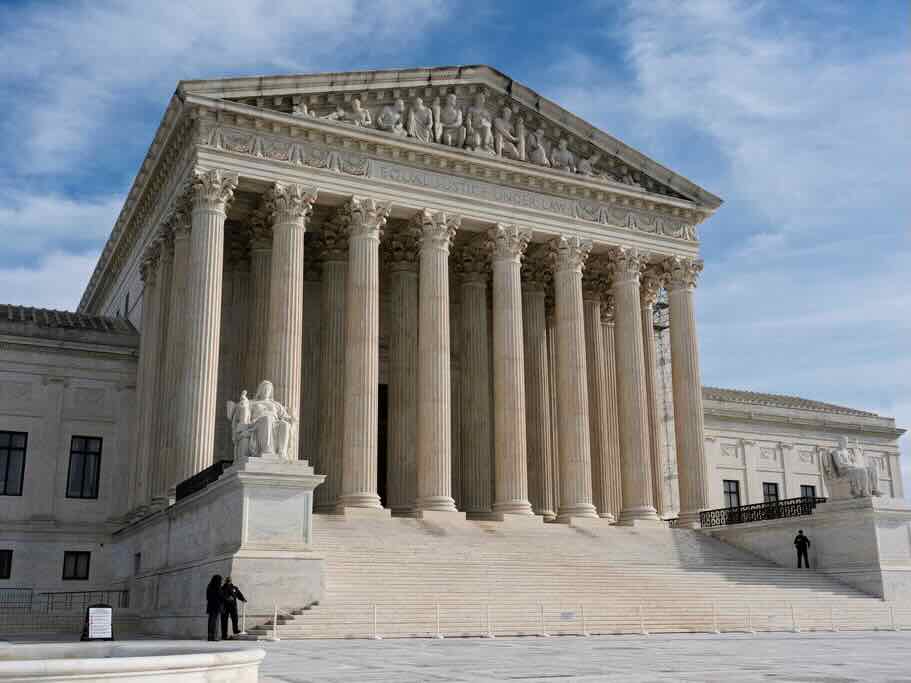
The Supreme Court handed down a major free speech ruling this week, siding 8 to 1 in a case about so-called “conversion therapy” for LGBTQ youth. All but Justice Ketanji Brown Jackson sided with Kaley Chiles, a Christian counselor practicing talk therapy in Colorado, in her challenge to the state’s ban.
The Case
In 2019, Colorado adopted a statute prohibiting licensed mental health professionals from engaging in what it defines as “conversion therapy” with patients under age 18. The law, which targets therapists, defines that as an effort “to change an individual’s sexual orientation or gender identity, including efforts to change behaviors or gender expressions or to eliminate or reduce sexual or romantic attraction or feelings toward individuals of the same sex.”
So, if Chiles were to counsel a patient suffering from gender dysphoria who wanted affirmation of their transgender identity, that is permissible under the law. If Chiles were to counsel a gender dysphoric patient who sought to grow comfortable with his or her natural body, it would be illegal.
Chiles challenged the law, and a district court denied her request to block enforcement while her challenge moved forward through the system. The Tenth Circuit Court of Appeals upheld the district court’s ruling in a divided panel, applying what is known as the “rational basis” test. That is the most lenient standard in constitutional law, where a law only needs to be rationally related to a legitimate government interest.
As such, Colorado was able to continue blocking Chiles from conducting talk therapy that supported clients seeking to become comfortable in their own bodies.
The Decision
Back in October, the Alliance Defending Freedom (ADF), on behalf of Chiles, argued before the high court that the Colorado law crosses a constitutional line by banning speech related to certain viewpoints while allowing others.
On Tuesday, the Supreme Court sided with Chiles, remanding the case back to the lower court and instructing them to apply “strict scrutiny” – the most demanding constitutional standard. Writing for the majority, Justice Neil Gorsuch framed the issue as a narrow but critical one: Whether Colorado’s law violates the First Amendment as applied to Chiles’ counseling and whether the lower court used the wrong legal test in upholding it.
“Consistent with the First Amendment’s jealous protections for the individual’s right to think and speak freely, this Court has long held that laws regulating speech based on its subject matter or ‘communicative content’ are ‘presumptively unconstitutional,'” he wrote. “As a general rule, such ‘content-based’ restrictions trigger ‘strict scrutiny,’ a demanding standard that requires the government to prove its restriction on speech is ‘narrowly tailored to serve compelling state interests.'”
The net-net: The Tenth Circuit applied the wrong level of scrutiny in upholding the law.
The Analysis
On Wednesday’s AM Update, ADF Chief Legal Counsel Jim Campbell, who argued the case in front of the court, explained what that higher standard requires:
“Because the Supreme Court has recognized that there is nothing more odious to the First Amendment than the idea that the government can pick and choose ideas and say some cannot be expressed and others can be. And so whenever the government’s engaged in viewpoint discrimination, the government has to meet a very, very high standard to justify silencing one view over another. In fact, the Supreme Court has never upheld a law that engages in viewpoint-based censorship, and every court that has considered laws like the one at issue here – involving counseling restrictions and applied strict scrutiny – they have all found that those laws don’t satisfy strict scrutiny. And so the Supreme Court’s decision today is the beginning of the end of applying these laws to silence counseling conversations between a counselor and their client.”
At the center of the argument was whether what is happening in these sessions is speech or simply regulated medical conduct. Campbell said the Court made clear it is protected speech:
“The Supreme Court said you can’t play a word game under the First Amendment. You can’t look at something that is obviously just a conversation between two people – a counselor and a client – and relabel that conduct. You have to recognize it for what it is, which is speech. And once we recognize that it is speech, then First Amendment protection applies. And once First Amendment protection applies, then the government can’t engage in viewpoint discrimination. Because that is precisely what Colorado is doing here, discriminating based on viewpoints. The First Amendment prevents the state from doing that.”
In arguing this ban applied to medical conduct, Colorado Solicitor General Shannon Stevenson told the court the medical community is in agreement that trans-identifying kids should only be affirmed in their gender confusion or they will suffer severe harm. During oral arguments, Justice Samuel Alito pressed Stevenson on that, noting the medical consensus has been wrong before, like when we used to sterilize the “feeble-minded.” More from Campbell:
“The so-called medical professionals don’t always get it right. We see that historically in that the professed experts have often been wrong throughout history, and eugenics is a great example of that. Here, what we have seen in the area of so-called gender medicine is the professionals getting it wrong for many, many years. They have been encouraging young people to pursue so-called medicalized transition, where they are pursuing drugs and procedures in order to resolve gender dysphoria. But the reality is, and what the best science now shows, is that what kids need is a listening ear, and they need the opportunity to talk through their feelings and their struggles, and that is what licensed counselors like Kaley Chiles want to provide.”
Campbell said the margin of the decision is significant, with nearly the entire Court agreeing the law crosses a constitutional line:
“It is an 8-1 opinion because viewpoint discrimination is so problematic. Almost the entire court recognized just how problematic it is. For the state of Colorado to pick one side of a debated moral, scientific, and religious issue and to allow one side to speak in the counseling room but not another side is a direct affront to the First Amendment. And so that is why nearly the entire court came together and recognized that this law violates First Amendment principles.”
As far as the lone dissenting vote, liberal Justice Jackson argued Colorado’s law is not targeting speech, but regulating medical treatments. “In the worst-case scenario, our medical system unravels as various licensed healthcare professionals… start broadly wielding their newfound constitutional right to provide substandard medical care,” she wrote in her dissent. Campbell disagreed:
“Certainly Justice Jackson didn’t even persuade Justice [Elena] Kagan or Justice [Sonia] Sotomayor of those views, and that’s because we have long regulated licensed professionals in this country, but we have never done so by silencing one view over another. Laws like Colorado’s are historical outliers. These laws have not traditionally been in place because what we’ve allowed professionals to do is to have open dialogues with their clients. What we haven’t done historically as a society is pick and choose views and shut down the ones that we don’t like, and that is what the Supreme Court reacted against today, and that is why the Supreme Court said that this law violates the First Amendment.”
The case now returns to the lower courts where it will be reconsidered under that higher constitutional standard in the months ahead. At least 20 other states have similar laws on the books, and Campbell predicts this ruling will significantly limit their enforcement.
You can get all the day’s headlines by tuning into the AM Update with Megyn Kelly on YouTube, Apple Podcasts, or wherever you like to listen. And don’t forget that you can catch AM Update on SiriusXM’s The Megyn Kelly Channel (channel 111).