
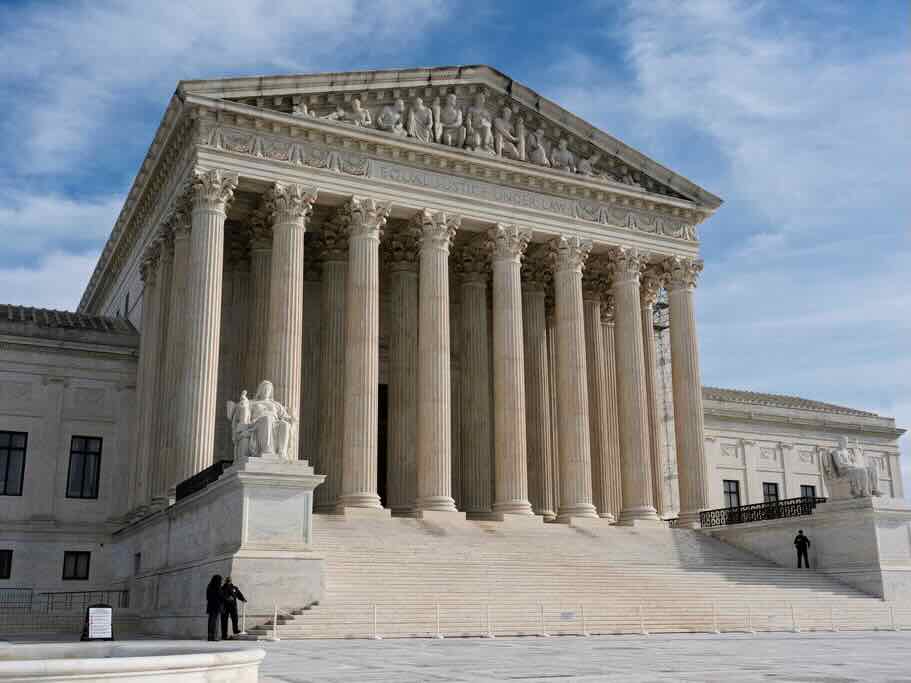
The U.S. Supreme Court dealt a serious blow to President Donald Trump’s sweeping tariff agenda Friday morning. In a 6–3 decision, the court ruled he cannot use emergency law to impose global tariffs, saying that authority belongs to Congress, not the president.
Chief Justice John Roberts, Justice Amy Coney Barrett, and Justice Neil Gorsuch sided with the three liberals on the court to strike down the tariffs, while Justices Clarence Thomas, Samuel Alito and Brett Kavanaugh dissented.
On Friday’s show, Megyn was joined by Will Chamberlain, senior counsel at the Article III Project, to break down the decision and what it means for the Trump administration.
The Decision
The court rejected the Trump administration’s argument that the 1977 International Emergency Economics Power Act (IEEPA) allowed the president to unilaterally impose tariffs without congressional approval. The president had used the law to impose tariffs related to trade imbalances and drug smuggling.
“They ruled 6-3 that the president cannot use the [IEEPA] to impose tariffs. That’s the extent of the ruling, and they didn’t even agree on the reasoning,” Chamberlain explained. “You had three justices – Chief Justice Roberts, Justice Gorsuch, and Justice Barrett – using the major questions doctrine, which is basically saying that, for a major delegation of congressional power, there needs to be a very explicit delegation of that power and they didn’t find that in this case. The three liberals just said the statute doesn’t authorize the tariffs.”
“And then Alito, Kavanaugh, and Thomas disagree with all that, saying pretty straightforwardly that the statute actually does authorize these tariffs,” he added. “But they were the losing side, so all these tariffs imposed under this particular statute are unlawful.”
Kavanaugh wrote the dissent, which Chamberlain said had the “best” argument. “I thought Congress clearly delegated this authority to the president, and it makes sense that they would because tariffs are so interwoven with our economic negotiations with foreign countries,” he noted. “You want the president to have the flexibility and the credibility to be able to impose terrorists when he needs to.”
The Fallout
The SCOTUS decision does not wipe out all of the president’s tariffs, but it appears to threaten an estimated $175 billion of the more than $200 billion the administration collected in 2025. Chamberlain said he believes those who paid the tariffs will be entitled to a refund.
“The Supreme Court didn’t really lay out the process here, other than to strongly suggest that all this will go to the United States Court of International Trade,” he said. “But all the refund litigation… that’s to be decided later. All the Supreme Court decided was that these tariffs were unlawful in the first instance.”
In his view, the court’s decision “weakens” but is not totally “devastating” to the Trump agenda. “It weakens it. I mean, there’s just no getting around that… The tariffs are a key part of the president’s arsenal in negotiating with foreign countries,” Chamberlain said. “If foreign countries know that Trump is a little more handcuffed in how he can impose tariffs they will be more reluctant to make concessions in trade negotiations. It’s as simple as that.”
“I think this was a bad ruling from the Supreme Court,” he added. “Is it devastating? No, but it is going to hurt the president and it’s going to hurt the country.”
Trump Responds
Speaking at a White House press briefing Friday afternoon, President Trump called the ruling “deeply disappointing” and said he is “ashamed of” certain members of the court. He also indicated his team has already pivoted. “Other alternatives will now be used to replace the ones that the court incorrectly rejected,” he said.
Additionally, Trump announced a new “global tariff” in response to the court’s decision. “Today I will sign an order to impose a 10 percent global tariff under section 122 over and above our normal tariffs already being charged,” the president explained. “And we’re also initiating several section 301 and other investigations to protect our country from unfair trading practices of other countries and companies.”
NBC News reported that section 122 of the Trade Act of 1974 allows the president to temporarily institute a “temporary import surcharge” of up to 15 percent if he finds there are “large and serious” balance-of-payments deficits, to prevent an “imminent” and “significant” depreciation of the U.S. dollar in foreign exchange markets.
Treasury Secretary Scott Bessent struck a similar tone on Friday, telling reporters the administration will adapt its tariff policies and pursue other legal authorities as needed. He said an estimate calculated by the Treasury Department found that using these alternative measures will “result in virtually unchanged tariff revenue in 2026.”
You can check out Megyn’s full interview with Chamberlain by tuning in to episode 1,257 on YouTube, Apple Podcasts, or wherever you like to listen. And don’t forget that you can catch The Megyn Kelly Show live on SiriusXM’s The Megyn Kelly Channel (channel 111) weekdays from 12pm to 2pm ET.