

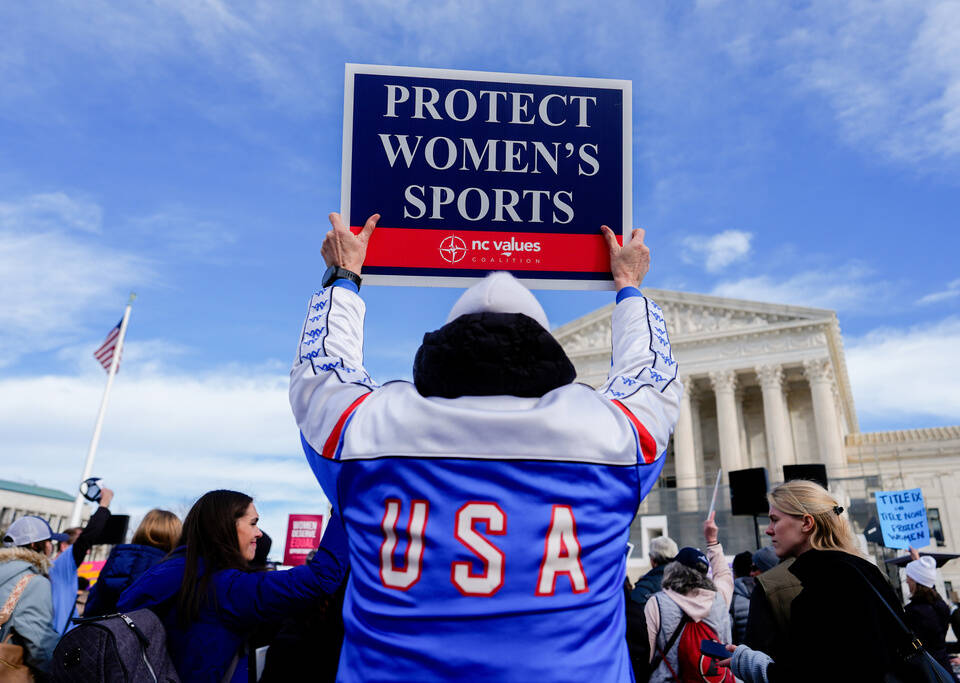
The U.S. Supreme Court heard oral arguments Tuesday on two key cases regarding the protection of women’s sports from so-called ‘transgender’ athletes.
Little v. Hecox and West Virginia v. B.P.J. both deal with the issue of whether states have the right to ban biological boys from girls sports. And after a marathon four-hour session of back-to-back arguments, the court’s conservative majority sounded poised to uphold the bans.
Megyn was at the Supreme Court to observe the arguments on Tuesday. After they wrapped, she was joined by Kristen Waggoner, president of Alliance Defending Freedom, to discuss the cases and how the justices seem likely to rule.
The Cases
There are currently 27 states with laws restricting or banning males from competing in female sports, while 23 states allow athletes to compete based on gender identity instead of biological sex. Both Little v. Hecox and West Virginia v. B.P.J. involve athletes who were born boys, now identify as girls, and wish to compete on women’s teams.
‘Trans’ athlete Lindsay Hecox, now 24 years old, filed his lawsuit after attempting to try out for the women’s track and cross-country teams at Boise State University in Idaho. The state’s 2020 Fairness in Women’s Sports Act bans biological boys and men from competing on girl’s and women’s sports teams in public schools from elementary school through college.
The West Virginia case involves B.P.J., a 15-year-old high school student who began publicly identifying as a girl in third grade. He takes puberty blockers and cross-sex hormones, and his mother went to court on his behalf after she learned the 2021 Save Women’s Sports Act would prevent B.P.J. from participating on the girls’ middle school track and field team.
Hecox and B.P.J. argued that the state bans violate Title IX and/or the Constitution’s equal protection clause under the Fourteenth Amendment. Lower courts ruled in favor of the ‘trans’ athletes, blocking Idaho and West Virginia’s laws from being implemented.
As a result, B.P.J. has been allowed to compete against girls. Waggoner, who has defended female athletes impacted by B.P.J.’s participation, said “423 girls have been affected a lost places” since he started competing and “he has taken 57 medals” that should have been awarded to girls.
She shared the story of ADL client Adaleia Cross, who attends the same school as B.P.J. “She was in the top three on her [shot put] team that had three spots. The first year, when B.P.J. was in sixth grade, [Cross] was in seventh grade, and, during that time, she was still in the top spot,” Waggoner explained. “By the next year, she starts getting knocked out. B.P.J. allegedly starting to throw 10 to 20 feet longer and all these girls are falling off because he is taking these spots in higher competition.”
Ruling Predictions
Last year, the Supreme Court ruled that states can ban transgender treatment for minors, and both Megyn and Waggoner believe the justices’ questioning during the oral arguments indicate they will reach a similar outcome in these cases.
“My own take on what happened today in the High Court [is] the court’s going to uphold the bans, so I think the 27 states are going to be happy,” Megyn said. “I think it is going to be 6-3 that the High Court will uphold those bans as constitutionally valid.”
Waggoner agreed and said she was generally pleased with how the day unfolded. “The argument went very well,” she said. “I was… delighted by some of the ACLU concessions. They essentially rolled back their arguments on Title IX altogether, even saying that the lower court decision that they won under was wrong. So, that’s great. I think the veil was brought back on the fact that they refused to even define what sex is.”
Additional Questions
But there is another issue at play in these cases that Megyn said is actually the “big kahuna.” It centers around the 23 states that allow boys and men to compete in girls and women’s sports. “What about the other states… that allow boys to participate in girls sports. Do the girls in those states have a right under Title IX or the Constitution to have those sports to themselves,” she asked. “In other words, can we overturn the permission slips that the blue states have given boys to participate in girls sports at the US Supreme Court?”
After listening to the arguments in their entirety, Megyn said she is less optimistic on that front. “Unfortunately, my strong read of the conservative justices today was they are ready to join with the libs in saying, ‘[Those laws are] just fine too,’” she added. “[Amy Coney] Barrett, [Neil] Gorsuch, and [Brett] Kavanaugh seemed a little shaky to me on that second piece of it. Surprisingly, I kind of got a good vibe from [Chief Justice John] Roberts on it, definitely [Samuel] Alito and [Clarence] Thomas. So, we’ll see.”
You can check out Megyn’s full interview with Waggoner by tuning in to episode 1,229 on YouTube, Apple Podcasts, or wherever you like to listen. And don’t forget that you can catch The Megyn Kelly Show live on SiriusXM’s The Megyn Kelly Channel (channel 111) weekdays from 12pm to 2pm ET.